We heard about the great birding in Ecuador while on the Jungle River Cruise in 2006, and decided we had to go there. We managed to recruit some friends, Jenny and Terry Cloudman, to join us on the trip, and met up with other members from the Jungle River Cruise.
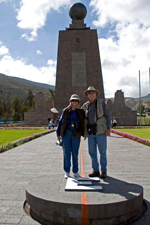
We've learned that it is prudent to arrive a day early for these trips; it gives your bags a chance to catch up with you early. So, we had an extra day in Quito. We spent it seeing the sights of the city, and took a side trip to Ciudad Mitad del Mundo, where the equator crosses the country. Jim and Linda briefly stood in opposite hemispheres.
The first week, we stayed at the Napo Wildlife Center. This is a fabulous place, which is obvious when you read the details of the trip there. First, we flew from Quito to the town of Coca, whose real name is allegedly Puerto Francisco de Orellana. The eponymous seņor Orellana sailed down the Napo river into the Amazon, reaching the mouth of the river in 1542.
He is a national hero in Ecuador, but apparently, that is not enough to keep his name on the town. Our flight to Coca took about 30 minutes on Vip (pronounced "beep") airlines. Then we took an open air jitney to the dock, where we boarded a large canoe-like boat for a 2½ hour, bladder stretching trip down the Napo river. Then we transferred to smaller dugout canoes for the trip up Añangu creek to the lodge. Along the way, we passed a nest of a Zigzag heron, and got a great photo of this elusive bird. We arrived at the lodge at dusk, settled into our cabin, and had a delicious, gourmet feast in the dining area.
We enjoyed five days of superb birding in areas near the lodge. One day, we went to two parrot licks
down river a bit. Hundreds of parrots gather at these sites to eat the clay, which contains minerals they need for their diet.
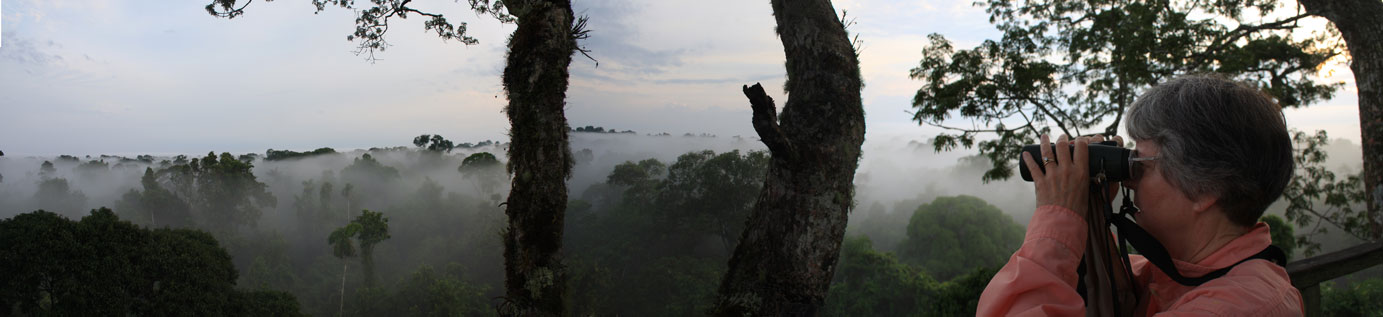
As spectacular as this was, our favorite birding location was the Canopy Tower, a platform built around a huge Ceiba tree 35 meters above ground. A set of 208 metal steps takes you to this wonderful vantage point. The photo above shows Linda gazing out over the forest shortly after dawn on our final day. We left the lodge after an early breakfast, crossed the lagoon in a dugout canoe, and hiked along a dark trail through the forest for thirty minutes to reach the platform. As you can see, as soon as it was light, we saw mist shrouding the trees. Not much stirred. A pair of Blue-and-yellow Macaws flew past. Gradually, the sun warmed the air and the mist rose — only to become a generalized fog even harder to see through. Finally, the sun burned off the fog, and we could see the trees below. Then, about twenty minutes later, all that water returned in the form of rain. We hunched down beneath waterproof ponchos provided by the center and waited.
The rain stopped after half an hour or so, and birds exploded from the treetops. We had several hours of unbelievable sightings, as insects came out and brought the birds out to feed on them. Several of these took up residence in “our tree,” giving us really close looks. One amazing sight was of a Pygmy Antwren, a bird that usually skulks around near the ground. A male began singing below our tree. Paul Greenfield, our guide, played a recording of the song, and the bird flew up near our canopy to challenge his rival. This unheard of behavior gave Jim an opportunity to snap a great closeup photo.
However, the best bird of the day was a fantastic Crested Eagle. We first saw it quite a distance away. Paul thought it might be an immature Black Hawk-eagle we'd seen earlier in the trip. He had not actually seen the other bird, but all of us had, and we responded in unison, “That's not the same bird.” When we got a look at in the scope, we saw that it was a Crested Eagle, a lifer for everyone but Paul. Then, the bird took off and did something totally unexpected, he flew closer and landed in a tree less than 100 meters from our own perch. Paul later suggested that the bird may have noticed us moving and come closer to see if we were monkeys, his favorite food. After realizing his mistake, the bird flew away, but not before Terry Cloudman got a great picture.
The day was not over! In the afternoon, we took a trip in a dugout canoe some way down Añangu Creek. Sixto, our Quichua guide, motioned to an area of water hyacinths to our left and whispered, “Giant Otter.” We had seen some of these magnificent predators earlier, but all the way across the lake, where we could make out their heads. Now, we had two of them within 20 feet of the canoe. Jim had time to grab his camera and get this photo as one of the animals raised his head to warn us not to mess around with him.
Photos from the Napo Wildlife Center.
Some other members of the tour group have posted photos on web sites for sharing photos:
Our trip consisted of two parts, one involving the Napo Wildlife Center, the other the Eastern Slope of the Andes. So, after returning to Quito, where some people left and some new ones joined us, we started the second half with a day trip to the western slope of the Andes. We headed out at dark o'clock, toward Mindo, with the prospect of some great birds we wouldn't see anywhere else.
![]()
After some quick birding in the fog on the way — we spotted the Blade-billed Mountain-toucan, the cover bird on the Birds of Ecuador — we pulled into Angel Paz's Reserve. Angel greeted us with a snack and tea. Angel used to be a farmer, growing tree tomatoes, a kind of fruit. Then, for some reason, he started feeding a Giant Antpitta (Grallaria gigantea) while calling “Maria,” his name for the bird. Gradually, Maria abandoned her shy ways and came out regularly. Birders heard of this and began flocking to Angel's to see the Antpitta. He started charging $5/birder. Soon, he was making more money from the birders than the tree tomatoes. He started working on other shy birds, and soon had several hard-to-see birds coming out to be fed.
Needless to say, Angel's place is now a required stop. In addition to the Antpittas, we also saw Dark-backed Wood-quail, another formerly shy and secretive bird, and many hummingbirds at feeders.
Then it was on to other places with hummingbirds. First, we stopped at Bellavista, a birder's lodge, where we ate a picnic lunch. Then Tony Nunnery's house. We saw new hummingbirds at every stop.
After another night spent in Quito, we set out for the Eastern slope. Our first day took us to the highest point of the trip, 13,500' (a bit over 4000m). This was the site of an antenna farm, where we saw a pair of Rufous-bellied Seedsnipe. Jim was too wiped out by the altitude to even think about taking pictures. He managed to drag himself out of the bus to see the Seedsnipe, though.
![]()
Finally descending to lower levels, we stopped for the night at Termas Papallacta, a resort spa at a mere 10000' (shaving 1000m off the altitude for you metric fans). This is a popular family spot as normal people require only about 1½ hours, instead of all day, to drive from Quito. This was easily the best hotel of the trip, equipped as it was with both a gourmet dining room, lovely grounds, and pools fed from the hot springs in the area. We luxuriated in the hot water until time for dinner.
![]()
The next morning was something Jim calls a “dictionary day,” when birding comes before breakfast. We took the bus up into somewhat higher elevation, where despite intermittent fog and rain, we spotted several nice feeding flocks before returning to the hotel for breakfast. Then, it was on to San Ysidro Labrador, our location for the rest of the trip. On the way, we stopped at Guango Lodge for some more hummingbirds, including the stunning Glowing Puffleg and the amazing Swordbill
, as well as the cute Chestnut-breasted Coronet.
You'd think that as we spent several days as SYL, we'd have lots of great photos. Alas, Jim decided it was time to get some good videos, and they are taking a bit more work than expected. We'll post them as they become available. Stay tuned for shots of the Black Agouti and other marvels. Part of the reason for the change was that we spent considerably more time hiking rather than riding around, and all that camera equipment gets heavy.
![]()
On the other hand, we did have one day when we traveled downslope to a park called Coca Falls. Just as with the city of Coca, this has another name, Cascada San Rafael, but no one seems to call it that. This was much lower elevation, with different birds, as well as the prettiest damselfly of the trip. Fortunately, there were so many of these flying around — and even laying eggs — that it was easy to get a good picture.
Finally, it was time to return to Quito and then fly home. We are already thinking about parts of Ecuador that we need to explore further. It is a beautiful country with fabulous forests and amazing wildlife.
Check out the Photo Gallery for more pictures from the trip.
A quick list of the birds seen (or in some cases heard) on the trip is online. If you want a more complete report with comments and everything, let me know.